Bimed Products Earn UKCA Certification for Continued Service to the UK Market
2026-04-15
A cable entry device allows one or more cables or optical fibres to enter electrical equipment while maintaining its type of explosion protection. Among the various types, flameproof cable entries are widely used and subject to demanding requirements. The sealing ring is a critical component: its performance directly affects the flameproof function. The source article attributes more than 90% of flameproof-entry failures to sealing-ring problems. This article discusses ring geometry, rubber selection and hardness.
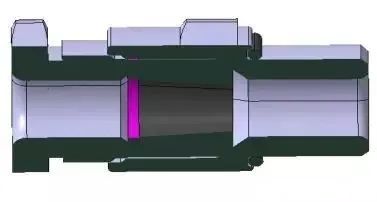
GB 3836.2-2010 distinguishes types of cable entry protection including flameproof and increased safety. Flameproof entries can use an elastomeric sealing ring or a compound barrier. Thread options include metric and NPT. The accompanying illustration shows a typical ring-type flameproof cable entry.
A compression component deforms the rubber ring so that it grips the cable. This helps prevent movement under tension or torque and stops an internal explosion from propagating through the cable entry into the external hazardous atmosphere. According to the cited GB 3836.1-2010 and GB 3836.2-2010 requirements, the sealing ring is subject to the following tests.
Ageing is tested with the cable clamped. Heat resistance is determined using the non-metallic component relevant to the integrity of the protection type—the sealing ring. If the maximum service temperature does not exceed 75°C, the specimen is held for 28 days at 90 ± 5% relative humidity and a temperature 20 ± 2°C above the maximum service temperature, with a minimum of 80°C. If the maximum service temperature exceeds 75°C, the four-week period is replaced by 14 days at 95 ± 2°C and 90 ± 5% relative humidity, followed by 14 days in an air oven at a temperature 20 ± 2 K above the maximum service temperature. After 24 hours at room temperature, the heat-aged specimen is tested for cold resistance by holding it for 24 hours at 5–10°C below the minimum service temperature.
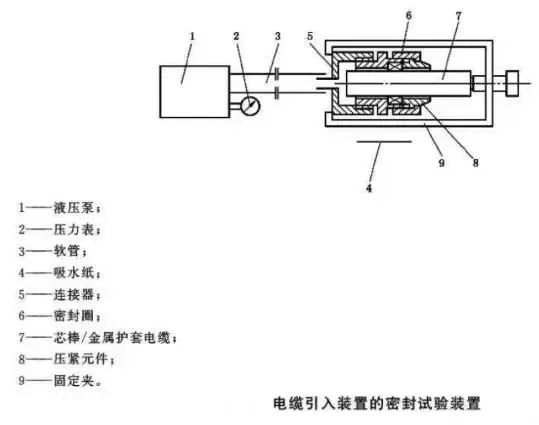
The entry must pass a sealing test. First, use a clean, polished, dry cylindrical mild-steel mandrel whose diameter equals the smallest cable diameter permitted by the manufacturer. Fit the ring into the entry and tighten the compression nut to the specified torque. The assembly should seal against a hydraulic pressure of 2 MPa for Group I and 3 MPa for Group II. Install it in the hydraulic test equipment and hold the respective pressure for 10 seconds. Coloured water may be used; absence of leakage marks on absorbent paper indicates a pass.
A mechanical-strength test then applies twice the torque needed for the sealing test to the compression component, subject to the minimum torque criterion stated in the source article: three times the maximum permitted circular-cable diameter, or the maximum permitted circumference of a non-circular cable. Dismantle and inspect the device. If no component is damaged, the test passes; damage to the sealing ring itself may be disregarded because this test assesses the mechanical strength of the entry.
Fit the ring to the smallest cable diameter specified by the manufacturer, or use a clean, polished, dry cylindrical mild-steel mandrel of the same diameter with a maximum surface roughness of Ra 1.6 μm. Apply the manufacturer’s tightening torque to prevent cable or mandrel slippage. Mount the prepared specimen in a tensile tester and apply a pulling force equal to 20 times the cable or mandrel diameter for six hours at 20 ± 5°C. Displacement not exceeding 6 mm is considered a pass.
The compression component squeezes the ring, which deforms and grips the cable. Adequate grip is needed to maintain sealing, alongside heat- and cold-ageing resistance. Vulcanized rubber can age more quickly under the influence of temperature and humidity, gradually losing elasticity and compromising the seal. Operating-temperature range, ageing resistance and tear resistance are therefore important material-selection criteria.
Ring deformation depends on the torque applied to the compression component. Testing is generally needed to determine a suitable minimum tightening torque for reliable installation and use.
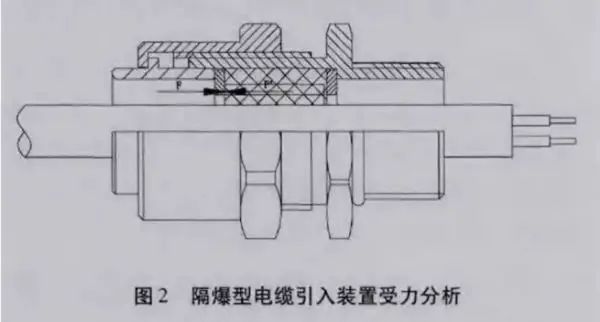
At the specified tightening torque, the compression component presses a washer against the sealing ring with force F; the ring exerts an equal and opposite reaction F′. Using the relationship F = P × S, and assuming constant pressure P, the contact area S increases with cable diameter. On that basis, a larger cable produces a higher gripping force.
The design should therefore be tested with the minimum permitted cable diameter. If that diameter passes the sealing test, the article reasons that the larger permitted diameter will have greater ring-to-cable gripping force.
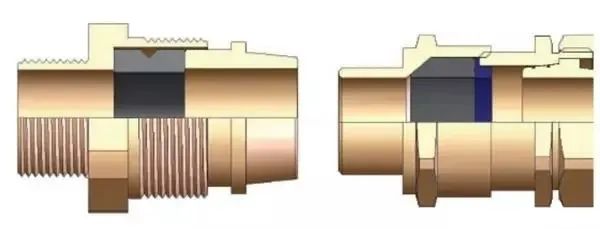
Two common geometries are compression-type and displacement-type rings. A compression-type ring typically has a V-shaped groove around its outside. Compression deforms the groove and tightens the ring around the cable. Such rings often cover a narrower cable-diameter range, and on the largest permitted cable the gripping force may become excessive, shortening cable life.
A displacement-type ring normally has a tapered front section and may have a tapered bore. The contact point changes with cable diameter, helping avoid excessive compression that could impair cable insulation and service life. The tapered bore can also provide a wider cable-diameter range than a compression-type ring.
Ring geometry and rubber choice are central to flameproof cable-entry design. To accommodate wide cable-diameter ranges and service at high or very low temperatures, designers commonly select heat- and tear-resistant silicone rubber and a displacement-type sealing geometry.